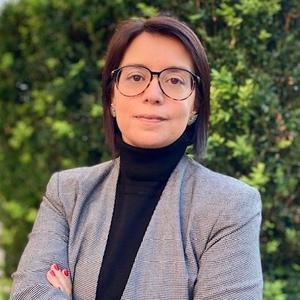
Inês Amaral is an Associate Professor with Habilitation in the Communication Section of the Department of Philosophy, Communication and Information (DFCI) at the Faculty of Arts and Humanities (FLUC), University of Coimbra. She coordinates the PhD Programme in Communication Sciences and is a member of the Coordinating Committee of the PhD Programme in Computational Media Design. She serves on the Scientific Committee of the DFCI and is a member of the Scientific Council of the Faculty of Arts and Humanities. Between September 2019 and May 2023, she served as Deputy Director of the DFCI, Coordinator of the Communication Section, and Director of the Bachelor's Degree Programme in Journalism and Communication.
She holds a PhD in Communication Sciences, specialising in Interactive Media, from the University of Minho. She is an integrated researcher at the Centre for Social Studies (CES), University of Coimbra, where she chairs the Ethics Committee, co-coordinates the Masculinities.pt Observatory, and is affiliated with the thematic research line "Europe and the Global South: Heritage and Dialogues". She is also a member of the Editorial Board of Revista Crítica de Ciências Sociais and a collaborating researcher at the Communication and Society Research Centre (CECS), University of Minho.
Her research has addressed participation and social media, audiences, feminist media studies, masculinities and media, media representations, media and digital literacies, technologies and active ageing, disinformation, online violence and hate speech, digital activism, and social movements.
She is the Principal Investigator of "(d)e-HATE – Exploring Cyber Hate: Online Racism Targeting Immigrant and Racialised Communities in Portugal" (2024.18170.PEX). She previously served as Principal Investigator of "MyGender – Young Adults' Mediated Practices: Promoting Gender Justice in and through Mobile Applications" (PTDC/COM-CSS/5947/2020) and Co-Principal Investigator of "MediaTrust.Lab – Regional Media Laboratory for Trust and Civic Literacy" (PTDC/COM-JOR/3866/2020). She was also Principal Investigator of "VIOxMulheres19 – Online Violence against Women: Preventing and Combating Misogyny and Violence in Digital Contexts Based on Experiences during the COVID-19 Pandemic" between July 2021 and July 2022.
She is a member of the research teams of "DeAppeal – Deconstruct and Resist Autocratic Appeal to Reinvigorate Democracy" (Horizon Europe, 101289057), "ProTest – Protest as a Democracy Test: Protest Culture under Transformation and as a Transformative Power" (Horizon Europe, 101177963), "NEXTDIGIMEDIA – Artificial Intelligence in Digital Media in Spain: Effects and Roles" (PID2024-156034OB-C22), "STORYline – Exploring Youth Citizenship through Intergenerational Approaches and Digital Narratives" (2023.11571.PEX), and "UnCoveR – Sexual Violence in Portuguese Media Landscapes" (2022.03964.PTDC).
She has participated in other nationally and internationally funded research projects, including "YouNDigital – Youth, News and Digital Citizenship" (PTDC/COM-OUT/0243/2021), "Equal.STEAM – Integrated Programme for Attracting and Retaining Girls and Women in Higher Education in Technology and Engineering Fields", "Gender in Hate Pandemics: Social Media, COVID-19 and Women Journalists" (FCT, ID 758936851), "DecoDeM – (De)Coding Masculinities" (PTDC/COM-CSS/31740/2017), "SMaRT-EU – Social Media Resilience Toolkit" (LC-01563446), "Opportunities and Challenges of Journalism in Open Environments" (CSO2016-80703-R), "MIA – Media in Action" (LC-00644630), "CEDAR – Consortium on Emerging Directions in Audience Research" (AH/M008681/1), "Digital Rights: A Password for the Future" (DECO/UAL), and "EMEDUS" (European Union). She also served as a scientific consultant for "(De)Othering – Deconstructing Risk and Otherness" (POCI-01-0145-FEDER-029997) and as the FLUC focal point for the European project SUPERA between November 2021 and May 2022.
She was an Invited Scientist Fellow at Universidad Carlos III de Madrid within the funded ENCAGE-CM project (S2015/HUM-3367), and a Visiting Professor at the University of Cape Verde and Agostinho Neto University in Angola. Her international academic activities include collaboration with European and African research teams, participation in international consortia, and the development of academic cooperation initiatives in communication, media, audience studies, gender, and social inequalities.
She is a member of COST Action CA23114 – "Regaining Linkage? Digital Technologies Improving Civic Engagement, Political Organisations and Democracy" and serves as Portugal's representative in COST Action CA21107 – "Work Inequalities in Later Life Redefined by Digitalization". She previously participated in COST Actions CA18230 – "Interactive Narrative Design for Complexity Representations"; CA17135 – "Constitution-Making and Deliberative Democracy"; CA15122 – "Reducing Old-Age Social Exclusion: Collaborations in Research and Policy"; IS1409 – "Gender and Health Impacts of Policies Extending Working Life in Western Countries"; IS1401 – "European Literacy Network"; IS1402 – "Ageism: A Multi-National, Interdisciplinary Perspective"; FP1104 – "New Possibilities for Print Media and Packaging: Combining Print with Digital"; and IS0906 – "Transforming Audiences, Transforming Societies".
Within academic associations, she serves as Vice-Chair of the Temporary Working Group on Media and Intimacy of the European Communication Research and Education Association (ECREA) and Coordinator of the Gender and Sexualities Working Group of the Portuguese Association of Communication Sciences (SOPCOM), where she previously served as Deputy Coordinator of the Journalism and Society Working Group.
She is a member of the Advisory Board of GILM, the Executive Committee of the Observatory of Online Journalism, the Media, Information and Literacy Observatory (MILObs), NIP-C@M, and the Portuguese team of the Global Media Monitoring Project. She is a member of the Civic Tech group of the Portuguese Association for the Promotion and Development of the Information Society (APDSI), which she co-coordinated between January 2018 and September 2021. She is also a co-founder of the Portuguese Association for Distance Education and Training.
Her scholarly output includes books, edited volumes, peer-reviewed journal articles, and book chapters published by national and international academic publishers. Her publications address audience studies, digital media, feminist media studies, gender, masculinities, media literacies, participation, disinformation, and social inequalities. Her work has appeared in journals such as International Journal of Communication, Social Media + Society, European Journal of Women's Studies, Journalism and Media, Social Sciences, Media Studies, Media & Jornalismo, Observatorio (OBS)*, and European Journal for Research on the Education and Learning of Adults, among others. She has also contributed to edited volumes published by Routledge, SAGE, Palgrave Macmillan, Emerald, and McGraw-Hill.
She is a certified trainer accredited by the Portuguese Ministry of Education, the Portuguese Journalists' Union, and the Scientific-Pedagogical Council for Continuing Education.
Contact
Colégio de São Jerónimo, 1st Floor
ines.amaral@uc.pt
Links
Selected Recent Publications
Moroni, J., & Amaral, I. (2026). Discurso de ódio na esfera digital: Algoritmos discriminatórios, propulsores de processos de geração de conflitos na opinião pública. In J. C. Correia, B. Fátima, I. Salvador, & H. Mugnaini (Eds.), Esfera pública na era dos algoritmos. Mediação algorítmica, experiência pública e futuro da democracia (pp. 111–130). LabCom.
García de Torres, E., Amaral, I., Jerónimo, P., & Cebrián Enrique, B. (Eds.). (2025). Open environments: Key challenges and opportunities for journalism. 25 years of online journalism. Participation, disinformation, disintermediation & artificial intelligence. McGraw-Hill. ISBN: 9788448631666.
Amaral, I., & Ventura, D. (2025). Representations of gender-based violence on The Handmaid's Tale Instagram page and audience engagement. European Journal of Women's Studies, 32(4), 480–496. https://doi.org/10.1177/13505068251375683
Amaral, I., & Ventura, D. (2025). Digital youth activism on Instagram: Racial justice, Black feminism, and literary mobilization in the case of Marley Dias. Journalism and Media, 6(3), Article 104. https://doi.org/10.3390/journalmedia6030104
Ventura, D., & Amaral, I. (2025). Racismo algorítmico e colonialismo digital: As literacias críticas na era da inteligência artificial. Revista Comunicando, 14(1). https://doi.org/10.58050/comunicando.v14i1.418
Amaral, I., Flores, A. M. M., Simões, R. B., & Antunes, E. (2025). Critical literacies and gender studies: Navigating media, education, and civic engagement for social justice. Emerald Publishing Limited. ISBN: 978-1-83662-595-7.
Jerónimo, P., & Amaral, I. (Eds.). (2025). Building media trust. LabCom.
Amaral, I., Simões, R. B., & Santos, S. J. (Eds.). (2025). Renegotiating masculinities in European digital spheres. Routledge. https://doi.org/10.4324/97810033441555
Amaral, I., Simões, R. B., & Flores, A. M. M. (Eds.). (2024). Young adulthood across digital platforms: Digitally constructing gender and sexualities. Emerald Group Publishing. ISBN: 978-1-83753-525-5.
Amaral, I., Flores, A. M. M., & Antunes, E. (Eds.). (2024). Apps e jovens adultos: Contributos para um mapeamento de práticas mediadas. UMinho Editora. https://doi.org/10.21814/uminho.ed.82